
Horse Health Conditions
Browse practical, easy-to-understand information about common equine health conditions.
Arthritis / Osteoarthritis
Coming SoonOsteoarthritis is particularly common in older horses, but it is not simply a condition of old age. It can occur in horses of any age and may be associated with previous injury, repeated loading, joint instability, conformation, intensive work or other joint disease. Although osteoarthritis cannot usually be reversed once established, appropriate veterinary treatment, management, exercise and nutritional support can
See what is comingBack Pain
Coming SoonBack pain should not automatically be assumed to originate in the back itself. Poor saddle fit, muscular strain, underlying orthopaedic problems, foot pain, altered movement and some medical conditions can all contribute. Important: Persistent, significant or unexplained back pain should be investigated by your veterinary surgeon. Treatment should be based on identifying the underlying cause rather than simply trying
See what is comingBit & Bridle Fitting
Coming SoonA bit and bridle are much more than pieces of equipment used to steer or control a horse. Together they form part of the communication system between horse and rider and sit against some extremely sensitive areas of the horse's head and mouth. Correct fit matters.
See what is comingBleeding
Coming SoonDetailed JCG Health Hub information is being prepared for this topic.
See what is comingBringing a Horse Back Into Work
Coming SoonDetailed JCG Health Hub information is being prepared for this topic.
See what is comingBruised Soles
Coming SoonDetailed JCG Health Hub information is being prepared for this topic.
See what is comingBruising
Coming SoonDetailed JCG Health Hub information is being prepared for this topic.
See what is comingBuilding and Maintaining Topline
Coming SoonDetailed JCG Health Hub information is being prepared for this topic.
See what is comingBurns and Scalds
Coming SoonDetailed JCG Health Hub information is being prepared for this topic.
See what is comingCellulitis
Coming SoonDetailed JCG Health Hub information is being prepared for this topic.
See what is comingChiropractic & Manual Therapy
Coming SoonDetailed JCG Health Hub information is being prepared for this topic.
See what is comingChoke
Coming SoonDetailed JCG Health Hub information is being prepared for this topic.
See what is comingChoosing an Equine Dental Professional
Coming SoonDetailed JCG Health Hub information is being prepared for this topic.
See what is comingColic
Coming SoonDetailed JCG Health Hub information is being prepared for this topic.
See what is comingCuts and Grazes
Coming SoonDetailed JCG Health Hub information is being prepared for this topic.
See what is comingDental Emergencies – When to Seek Help
Coming SoonDetailed JCG Health Hub information is being prepared for this topic.
See what is comingDiarrhoea
Supporting horse owners with practical information, early warning signs and appropriate nutritional support. Diarrhoea can range from mildly loose droppings to frequent, very watery faeces. While a temporary change in droppings may sometimes follow a change in diet, grazing or routine, significant or persistent diarrhoea should never simply be assumed to be a digestive upset.
Read moreEIPH
Coming SoonExercise-Induced Pulmonary Haemorrhage (EIPH) is bleeding that occurs within a horse's lungs during or following strenuous exercise. You may also hear a horse with EIPH described as a “bleeder.”
See what is comingEquine Asthma
Coming SoonEquine asthma is a long-term inflammatory condition affecting the horse's lower airways — the tubes that carry air into and through the lungs. When these airways become inflamed, they can become more sensitive and reactive. The lining may swell, more mucus can be produced and the muscles surrounding the airways can tighten. Together, these changes make it more difficult for air to move freely through the lungs.
See what is comingEquine Dentistry
Coming SoonA horse’s mouth is a complex working system. The teeth, jaw, chewing muscles, tongue, gums and the way the upper and lower teeth meet all work together. Problems in any one part can affect comfort, chewing efficiency, ridden performance and, in some cases, the horse’s ability to maintain weight and condition.
See what is coming
Equine Metabolic Syndrome
Equine Metabolic Syndrome, commonly shortened to EMS, is a metabolic condition in which a horse or pony has an abnormal response to insulin. This is known as insulin dysregulation.
Read moreEquine Physiotherapy
Coming SoonPhysiotherapists, chiropractors, osteopaths and other appropriately qualified musculoskeletal practitioners can all play an important role in keeping horses comfortable, helping them recover following injury and supporting their movement and performance. But the different titles can be confusing.
See what is comingEye Injuries
Coming SoonDetailed JCG Health Hub information is being prepared for this topic.
See what is comingFarriery & Hoof Care
Coming SoonThe old saying “No foot, no horse” still contains an important truth. A horse's feet support its entire body, interact with the ground at every stride and influence how comfortably and efficiently the horse moves.
See what is comingFeeding a Horse in Light Work
Coming SoonDetailed JCG Health Hub information is being prepared for this topic.
See what is coming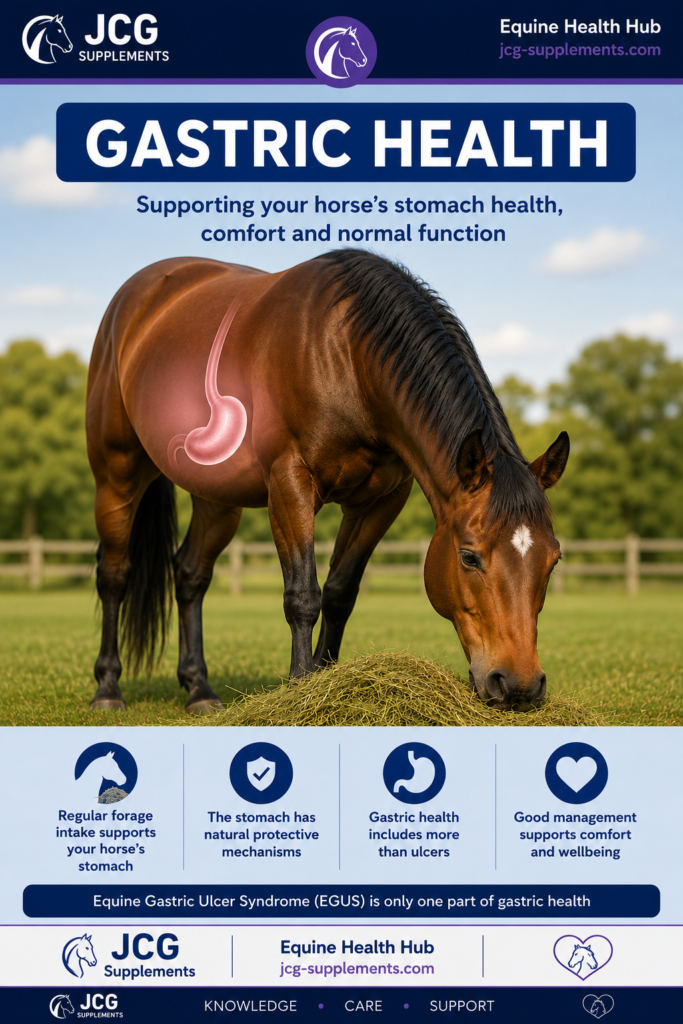
Gastric Health
Gastric health describes the health, comfort and normal function of the horse’s stomach. The stomach begins the process of digesting food and produces acid to help break down the horse’s feed. Unlike people, horses produce gastric acid continuously, including during periods when they are not eating.
Read moreGastric Ulcers / EGUS
Coming SoonSupporting horse owners with practical information, management guidance and nutritional support. Gastric ulcers are relatively common in horses, particularly where feeding, exercise, travel, stabling or other aspects of management increase exposure of the stomach lining to acid or place additional demands on its natural protective mechanisms.
See what is comingHindgut Health
Coming SoonYour horse's hindgut plays a major role in digestion, particularly in breaking down fibre and helping the horse obtain energy from forage. Unlike some of the conditions covered within the JCG Health Hub, poor hindgut health is not a single disease or diagnosis. Changes in diet, management, stress, illness and other factors can affect the hindgut environment and the microorganisms living within it.
See what is comingHives / Urticaria
Coming SoonDetailed JCG Health Hub information is being prepared for this topic.
See what is comingHoof Abscesses
Coming SoonImportant: Sudden severe lameness should not automatically be assumed to be a hoof abscess. Fractures, penetrating injuries and other serious conditions can produce similar signs. If your horse is severely lame, the cause is uncertain, or there is a wound or object penetrating the hoof, seek veterinary advice promptly.
See what is comingHoof Cracks
Coming SoonSeek professional advice promptly if a hoof crack is associated with lameness, heat, swelling, bleeding, discharge, significant separation or movement of the hoof wall, or appears to extend into sensitive tissue. The hoof wall is a tough but continuously growing structure that bears and distributes substantial forces every time the horse moves.
See what is comingHorse Owner’s First Aid
Coming SoonDetailed JCG Health Hub information is being prepared for this topic.
See what is comingHyperlipemia
Coming SoonSupporting horse owners with practical information about recognising risk, seeking veterinary help and supporting appropriate nutritional management. Hyperlipemia is a potentially serious metabolic condition in which very high levels of fat enter the bloodstream. It can occur when a horse, pony or donkey is not consuming enough energy and the body begins mobilising large quantities of stored fat.
See what is comingInfluenza
Coming SoonEquine influenza — usually called equine flu — is a highly contagious viral infection affecting the horse's respiratory system. It can spread very quickly wherever horses mix, including livery yards, competition venues, training yards, sales, studs and equestrian events. Horses can also potentially encounter infection without travelling themselves if infected horses, people or contaminated equipment introduce the vir
See what is comingInsulin Dysregulation
Coming SoonFreeStep nutritional support for this condition: [Lamialert] · [Lamialert CSH] Insulin is a hormone produced by the pancreas. One of its important roles is helping regulate the amount of glucose circulating in the blood.
See what is coming
Joint Mobility and Stiffness
Joint stiffness is usually noticed when movement becomes less free. Your horse may take longer to loosen up, appear less willing to bend, struggle on tight circles, or seem more uncomfortable after rest, hard work, cold weather or travelling.
Read moreLameness
Coming SoonIt can be very obvious, with a horse clearly protecting one limb or being reluctant to bear weight on it. But it can also be extremely subtle — perhaps appearing only as stiffness, uneven movement, altered rhythm, reluctance to turn or an unexplained reduction in performance. Lameness is not a single disease. It tells us that something is affecting the horse's normal mobility or function. The changes we actually see
See what is coming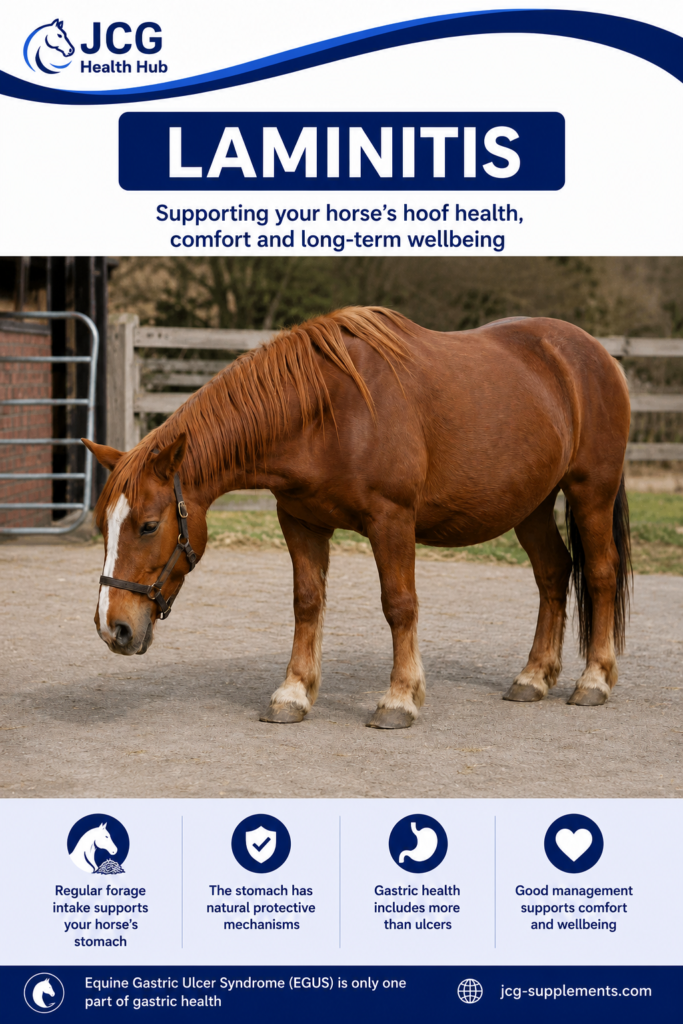
Laminitis
Understand what laminitis is, recognise the early warning signs and learn the practical management steps that can support your horse.
Read moreLice
Coming SoonDetailed JCG Health Hub information is being prepared for this topic.
See what is comingLigament Injuries
Coming SoonA horse may be diagnosed with a suspensory ligament injury, proximal suspensory desmitis, collateral ligament injury, check ligament injury or another ligament problem. These names can sound complicated, but understanding where the affected structure is and what it normally does can make the diagnosis much easier to understand.
See what is comingLumps and Swellings
Coming SoonDetailed JCG Health Hub information is being prepared for this topic.
See what is comingMaintaining a Healthy Digestive System
Coming SoonA horse’s digestive system is designed for frequent intake of fibre-rich food and almost continuous movement. Modern management can sometimes be very different, with restricted turnout, meal feeding, concentrates, travel, competition and changes in routine all potentially affecting digestive health.
See what is comingMaintaining Joint & Muscle Health
Coming SoonHealthy movement depends on much more than the joints alone. Bones, joints, muscles, tendons and ligaments all work together, while the horse's feet, body condition, workload, fitness and recovery also influence how comfortably the horse moves. Maintaining joint and muscle health is therefore not simply something to think about when a horse becomes older or develops a problem. It is part of everyday management throug
See what is comingMallenders & Sallenders
Coming SoonDetailed JCG Health Hub information is being prepared for this topic.
See what is comingManaging a Horse on Box Rest
Coming SoonDetailed JCG Health Hub information is being prepared for this topic.
See what is comingManaging an Overweight Horse or Good Doer
Coming SoonDetailed JCG Health Hub information is being prepared for this topic.
See what is comingManaging Restricted Grazing
Coming SoonDetailed JCG Health Hub information is being prepared for this topic.
See what is comingManaging Weight Through Spring Grass
Coming SoonDetailed JCG Health Hub information is being prepared for this topic.
See what is comingMelanoma
Coming SoonDetailed JCG Health Hub information is being prepared for this topic.
See what is comingMetabolic Laminitis
Coming SoonLaminitis is a painful and potentially serious condition affecting the sensitive structures that support the pedal bone within the hoof. When metabolic factors are involved, controlling the underlying metabolic problem is an important part of reducing the risk of further episodes. Laminitis describes inflammation and damage within the lamellae of the hoof — the specialised tissues that help suspend the pedal bone ins
See what is comingMites
Coming SoonDetailed JCG Health Hub information is being prepared for this topic.
See what is comingMud Fever
Coming SoonDetailed JCG Health Hub information is being prepared for this topic.
See what is comingMuscle Disorders
Coming SoonHealthy muscles are essential for much more than athletic performance. They help your horse move, maintain posture, stabilise joints, support the back and carry a rider comfortably. Muscle problems can range from relatively simple soreness or loss of condition to specific disorders affecting the way muscle cells produce and use energy.
See what is comingMy Horse Has a Dull Coat
Coming SoonDetailed JCG Health Hub information is being prepared for this topic.
See what is comingMy Horse Has Itchy Skin
Coming SoonDetailed JCG Health Hub information is being prepared for this topic.
See what is comingMy Horse Has Loose Droppings
Coming SoonDetailed JCG Health Hub information is being prepared for this topic.
See what is comingMy Horse Has Poor Hoof Quality
Coming SoonDetailed JCG Health Hub information is being prepared for this topic.
See what is comingMy Horse Has Suddenly Gone Off Its Feed
Coming SoonDetailed JCG Health Hub information is being prepared for this topic.
See what is comingMy Horse Has Swollen Legs
Coming SoonDetailed JCG Health Hub information is being prepared for this topic.
See what is comingMy Horse is Anxious or Difficult to Settle
Coming SoonDetailed JCG Health Hub information is being prepared for this topic.
See what is comingMy Horse is Drinking More Than Usual
Coming SoonDetailed JCG Health Hub information is being prepared for this topic.
See what is comingMy Horse is Losing Muscle
Coming SoonDetailed JCG Health Hub information is being prepared for this topic.
See what is comingMy Horse is Stiff
Coming SoonDetailed JCG Health Hub information is being prepared for this topic.
See what is comingMy Horse is Sweating Excessively
Coming SoonDetailed JCG Health Hub information is being prepared for this topic.
See what is comingMy Horse Isn’t Performing as Well as Usual
Coming SoonDetailed JCG Health Hub information is being prepared for this topic.
See what is comingMy Horse Keeps Coughing
Coming SoonDetailed JCG Health Hub information is being prepared for this topic.
See what is comingMy Horse Keeps Getting Hoof Abscesses
Coming SoonDetailed JCG Health Hub information is being prepared for this topic.
See what is comingMy Horse Needs to Gain Weight
Coming SoonDetailed JCG Health Hub information is being prepared for this topic.
See what is comingMy Horse Seems Lethargic
Coming SoonDetailed JCG Health Hub information is being prepared for this topic.
See what is comingObesity
Coming SoonDetailed JCG Health Hub information is being prepared for this topic.
See what is comingPersistent Coughing
Coming SoonAn occasional cough does not necessarily mean that a horse is unwell. Horses may cough briefly when dust or other material irritates the airways. But a cough that keeps returning, happens regularly during exercise, appears at particular times of day or continues over several days can be telling you that something is affecting the respiratory system.
See what is comingPhotosensitisation
Coming SoonDetailed JCG Health Hub information is being prepared for this topic.
See what is comingPneumonia
Coming SoonUnlike a simple cough or mild airway irritation, pneumonia can make a horse systemically unwell. Early veterinary assessment is therefore important. Pneumonia affects: The lungs and lower respiratory tract
See what is comingPoor Hoof Quality
Coming SoonPoor hoof quality is not a single disease. It is a description owners may use when the hoof wall becomes brittle, crumbly, weak, slow growing or prone to breaking, splitting and losing shoes. Hoof horn grows slowly, so changes made today may take several months to become clearly visible. Good hoof quality depends on much more than simply feeding a hoof supplement: nutrition, farriery or trimming, environment, workloa
See what is coming
PPID (Cushings Disease)
🩺 What is PPID? PPID stands for Pituitary Pars Intermedia Dysfunction. It is a hormonal condition involving part of the pituitary gland, which is located at the base…
Read morePPID / Cushing’s
Coming SoonDetailed JCG Health Hub information is being prepared for this topic.
See what is comingPreparing Your Horse for Winter
Coming SoonDetailed JCG Health Hub information is being prepared for this topic.
See what is comingProud Flesh
Coming SoonDetailed JCG Health Hub information is being prepared for this topic.
See what is comingRain Scald
Coming SoonDetailed JCG Health Hub information is being prepared for this topic.
See what is comingRespiratory Allergies
Coming SoonHorses breathe enormous volumes of air, particularly during exercise. Along with that air they can inhale tiny particles from hay, bedding, arena surfaces, pollen, mould spores and the general stable environment. For some horses, these particles cause much more than an occasional cough. Their airways can become irritated and inflamed and may narrow or produce additional mucus, making it harder for air to move freely.
See what is coming
Respiratory Health
🫁 What is respiratory health? Respiratory health describes the normal function, comfort and resilience of the horse's respiratory system. The respiratory system brings oxygen into the body and…
Read moreRingworm
Coming SoonDetailed JCG Health Hub information is being prepared for this topic.
See what is comingSaddle Fitting
Coming SoonDetailed JCG Health Hub information is being prepared for this topic.
See what is comingSand Accumulation
Detailed JCG Health Hub information is being prepared for this topic.
Read moreSarcoids
Coming SoonDetailed JCG Health Hub information is being prepared for this topic.
See what is comingSigns Your Horse May Have a Dental Problem
Coming SoonDetailed JCG Health Hub information is being prepared for this topic.
See what is comingStrangles
Coming SoonStrangles is one of the best-known infectious diseases of horses. It is caused by the bacterium Streptococcus equi subspecies equi, often shortened by vets to Strep. equi or S. equi. The infection commonly affects the lymph nodes — the small glands involved in the immune system — around the horse's head and throat. These can become enlarged, painful and filled with pus, sometimes forming abscesses that eventually bur
See what is coming
Stress and Anxiety
🧠 What are stress and anxiety? Stress prepares the horse to respond to a demand, challenge or possible threat. In the short term this is normal and useful.…
Read moreSupporting an Older Horse
Coming SoonDetailed JCG Health Hub information is being prepared for this topic.
See what is comingSweet Itch
Coming SoonDetailed JCG Health Hub information is being prepared for this topic.
See what is comingTendon Injuries
Coming SoonTendons are strong, slightly elastic bands of tissue that connect muscles to bones. They transfer the force produced by the muscles so that the horse's joints and limbs can move. In the lower limb, some tendons also act rather like springs. They stretch slightly as the limb takes weight and then release that stored energy as the horse moves forward. This is one reason horses can move so efficiently – but it also mean
See what is comingThrush
Coming SoonThrush is often associated with wet, dirty conditions, but environment is only part of the picture. Hoof shape, frog health, movement, trimming or shoeing, and how effectively the hoof cleans itself can all influence whether thrush develops. Thrush is an infection affecting the soft tissues of the frog, particularly the grooves running alongside the frog and the central groove between the heels.
See what is comingTying-Up
Coming Soon“Tying up” is the commonly used name for an episode in which a horse develops painful muscle damage, usually associated with exercise. You may also hear your vet describe it as exertional rhabdomyolysis (ER). In everyday language, this means that muscle cells have been damaged during or around exercise and their normal contents begin to leak into the bloodstream.
See what is comingUnderstanding Common Dental Findings
Coming SoonDetailed JCG Health Hub information is being prepared for this topic.
See what is comingUnderstanding Your Horse’s Dental Health
Coming SoonDetailed JCG Health Hub information is being prepared for this topic.
See what is comingWhen to Call the Vet
Coming SoonDetailed JCG Health Hub information is being prepared for this topic.
See what is comingWhite Line Disease
Coming SoonEarly recognition, removal of damaged horn and correction of the factors that allowed the separation to develop are important parts of successful management. White line disease is a condition in which the inner layers of the hoof wall become separated and damaged.
See what is comingWorms & Parasites
Coming SoonSupporting horse owners with practical information on parasite testing, pasture management and responsible worm control. This conditions page gives you an overview of worms and parasites in horses. Our downloadable Worms & Parasites User Guide provides more detailed information to help you develop a practical parasite-control programme for your horse.
See what is comingWounds
Coming SoonDetailed JCG Health Hub information is being prepared for this topic.
See what is comingBleeding
Coming SoonDetailed JCG Health Hub information is being prepared for this topic.
See what is comingBruising
Coming SoonDetailed JCG Health Hub information is being prepared for this topic.
See what is comingBurns and Scalds
Coming SoonDetailed JCG Health Hub information is being prepared for this topic.
See what is comingCuts and Grazes
Coming SoonDetailed JCG Health Hub information is being prepared for this topic.
See what is comingEye Injuries
Coming SoonDetailed JCG Health Hub information is being prepared for this topic.
See what is comingHorse Owner’s First Aid
Coming SoonDetailed JCG Health Hub information is being prepared for this topic.
See what is comingLumps and Swellings
Coming SoonDetailed JCG Health Hub information is being prepared for this topic.
See what is comingWhen to Call the Vet
Coming SoonDetailed JCG Health Hub information is being prepared for this topic.
See what is comingWounds
Coming SoonDetailed JCG Health Hub information is being prepared for this topic.
See what is comingCellulitis
Coming SoonDetailed JCG Health Hub information is being prepared for this topic.
See what is comingHives / Urticaria
Coming SoonDetailed JCG Health Hub information is being prepared for this topic.
See what is comingLice
Coming SoonDetailed JCG Health Hub information is being prepared for this topic.
See what is comingMallenders & Sallenders
Coming SoonDetailed JCG Health Hub information is being prepared for this topic.
See what is comingMelanoma
Coming SoonDetailed JCG Health Hub information is being prepared for this topic.
See what is comingMites
Coming SoonDetailed JCG Health Hub information is being prepared for this topic.
See what is comingMud Fever
Coming SoonDetailed JCG Health Hub information is being prepared for this topic.
See what is comingPhotosensitisation
Coming SoonDetailed JCG Health Hub information is being prepared for this topic.
See what is comingProud Flesh
Coming SoonDetailed JCG Health Hub information is being prepared for this topic.
See what is comingRain Scald
Coming SoonDetailed JCG Health Hub information is being prepared for this topic.
See what is comingRingworm
Coming SoonDetailed JCG Health Hub information is being prepared for this topic.
See what is comingSarcoids
Coming SoonDetailed JCG Health Hub information is being prepared for this topic.
See what is comingSweet Itch
Coming SoonDetailed JCG Health Hub information is being prepared for this topic.
See what is comingChoke
Coming SoonDetailed JCG Health Hub information is being prepared for this topic.
See what is comingColic
Coming SoonDetailed JCG Health Hub information is being prepared for this topic.
See what is comingDiarrhoea
Supporting horse owners with practical information, early warning signs and appropriate nutritional support. Diarrhoea can range from mildly loose droppings to frequent, very watery faeces. While a temporary change in droppings may sometimes follow a change in diet, grazing or routine, significant or persistent diarrhoea should never simply be assumed to be a digestive upset.
Read moreGastric Ulcers / EGUS
Coming SoonSupporting horse owners with practical information, management guidance and nutritional support. Gastric ulcers are relatively common in horses, particularly where feeding, exercise, travel, stabling or other aspects of management increase exposure of the stomach lining to acid or place additional demands on its natural protective mechanisms.
See what is comingHindgut Health
Coming SoonYour horse's hindgut plays a major role in digestion, particularly in breaking down fibre and helping the horse obtain energy from forage. Unlike some of the conditions covered within the JCG Health Hub, poor hindgut health is not a single disease or diagnosis. Changes in diet, management, stress, illness and other factors can affect the hindgut environment and the microorganisms living within it.
See what is comingMaintaining a Healthy Digestive System
Coming SoonA horse’s digestive system is designed for frequent intake of fibre-rich food and almost continuous movement. Modern management can sometimes be very different, with restricted turnout, meal feeding, concentrates, travel, competition and changes in routine all potentially affecting digestive health.
See what is comingSand Accumulation
Detailed JCG Health Hub information is being prepared for this topic.
Read moreWorms & Parasites
Coming SoonSupporting horse owners with practical information on parasite testing, pasture management and responsible worm control. This conditions page gives you an overview of worms and parasites in horses. Our downloadable Worms & Parasites User Guide provides more detailed information to help you develop a practical parasite-control programme for your horse.
See what is comingEquine Metabolic Syndrome
Equine Metabolic Syndrome, commonly shortened to EMS, is a metabolic condition in which a horse or pony has an abnormal response to insulin. This is known as insulin dysregulation.
Read moreHyperlipemia
Coming SoonSupporting horse owners with practical information about recognising risk, seeking veterinary help and supporting appropriate nutritional management. Hyperlipemia is a potentially serious metabolic condition in which very high levels of fat enter the bloodstream. It can occur when a horse, pony or donkey is not consuming enough energy and the body begins mobilising large quantities of stored fat.
See what is comingInsulin Dysregulation
Coming SoonFreeStep nutritional support for this condition: [Lamialert] · [Lamialert CSH] Insulin is a hormone produced by the pancreas. One of its important roles is helping regulate the amount of glucose circulating in the blood.
See what is comingMetabolic Laminitis
Coming SoonLaminitis is a painful and potentially serious condition affecting the sensitive structures that support the pedal bone within the hoof. When metabolic factors are involved, controlling the underlying metabolic problem is an important part of reducing the risk of further episodes. Laminitis describes inflammation and damage within the lamellae of the hoof — the specialised tissues that help suspend the pedal bone ins
See what is comingObesity
Coming SoonDetailed JCG Health Hub information is being prepared for this topic.
See what is comingPPID / Cushing’s
Coming SoonDetailed JCG Health Hub information is being prepared for this topic.
See what is comingBruised Soles
Coming SoonDetailed JCG Health Hub information is being prepared for this topic.
See what is comingHoof Abscesses
Coming SoonImportant: Sudden severe lameness should not automatically be assumed to be a hoof abscess. Fractures, penetrating injuries and other serious conditions can produce similar signs. If your horse is severely lame, the cause is uncertain, or there is a wound or object penetrating the hoof, seek veterinary advice promptly.
See what is comingHoof Cracks
Coming SoonSeek professional advice promptly if a hoof crack is associated with lameness, heat, swelling, bleeding, discharge, significant separation or movement of the hoof wall, or appears to extend into sensitive tissue. The hoof wall is a tough but continuously growing structure that bears and distributes substantial forces every time the horse moves.
See what is comingLaminitis
Understand what laminitis is, recognise the early warning signs and learn the practical management steps that can support your horse.
Read morePoor Hoof Quality
Coming SoonPoor hoof quality is not a single disease. It is a description owners may use when the hoof wall becomes brittle, crumbly, weak, slow growing or prone to breaking, splitting and losing shoes. Hoof horn grows slowly, so changes made today may take several months to become clearly visible. Good hoof quality depends on much more than simply feeding a hoof supplement: nutrition, farriery or trimming, environment, workloa
See what is comingThrush
Coming SoonThrush is often associated with wet, dirty conditions, but environment is only part of the picture. Hoof shape, frog health, movement, trimming or shoeing, and how effectively the hoof cleans itself can all influence whether thrush develops. Thrush is an infection affecting the soft tissues of the frog, particularly the grooves running alongside the frog and the central groove between the heels.
See what is comingWhite Line Disease
Coming SoonEarly recognition, removal of damaged horn and correction of the factors that allowed the separation to develop are important parts of successful management. White line disease is a condition in which the inner layers of the hoof wall become separated and damaged.
See what is comingArthritis / Osteoarthritis
Coming SoonOsteoarthritis is particularly common in older horses, but it is not simply a condition of old age. It can occur in horses of any age and may be associated with previous injury, repeated loading, joint instability, conformation, intensive work or other joint disease. Although osteoarthritis cannot usually be reversed once established, appropriate veterinary treatment, management, exercise and nutritional support can
See what is comingBack Pain
Coming SoonBack pain should not automatically be assumed to originate in the back itself. Poor saddle fit, muscular strain, underlying orthopaedic problems, foot pain, altered movement and some medical conditions can all contribute. Important: Persistent, significant or unexplained back pain should be investigated by your veterinary surgeon. Treatment should be based on identifying the underlying cause rather than simply trying
See what is comingLameness
Coming SoonIt can be very obvious, with a horse clearly protecting one limb or being reluctant to bear weight on it. But it can also be extremely subtle — perhaps appearing only as stiffness, uneven movement, altered rhythm, reluctance to turn or an unexplained reduction in performance. Lameness is not a single disease. It tells us that something is affecting the horse's normal mobility or function. The changes we actually see
See what is comingLigament Injuries
Coming SoonA horse may be diagnosed with a suspensory ligament injury, proximal suspensory desmitis, collateral ligament injury, check ligament injury or another ligament problem. These names can sound complicated, but understanding where the affected structure is and what it normally does can make the diagnosis much easier to understand.
See what is comingMaintaining Joint & Muscle Health
Coming SoonHealthy movement depends on much more than the joints alone. Bones, joints, muscles, tendons and ligaments all work together, while the horse's feet, body condition, workload, fitness and recovery also influence how comfortably the horse moves. Maintaining joint and muscle health is therefore not simply something to think about when a horse becomes older or develops a problem. It is part of everyday management throug
See what is comingMuscle Disorders
Coming SoonHealthy muscles are essential for much more than athletic performance. They help your horse move, maintain posture, stabilise joints, support the back and carry a rider comfortably. Muscle problems can range from relatively simple soreness or loss of condition to specific disorders affecting the way muscle cells produce and use energy.
See what is comingTendon Injuries
Coming SoonTendons are strong, slightly elastic bands of tissue that connect muscles to bones. They transfer the force produced by the muscles so that the horse's joints and limbs can move. In the lower limb, some tendons also act rather like springs. They stretch slightly as the limb takes weight and then release that stored energy as the horse moves forward. This is one reason horses can move so efficiently – but it also mean
See what is comingTying-Up
Coming Soon“Tying up” is the commonly used name for an episode in which a horse develops painful muscle damage, usually associated with exercise. You may also hear your vet describe it as exertional rhabdomyolysis (ER). In everyday language, this means that muscle cells have been damaged during or around exercise and their normal contents begin to leak into the bloodstream.
See what is comingEIPH
Coming SoonExercise-Induced Pulmonary Haemorrhage (EIPH) is bleeding that occurs within a horse's lungs during or following strenuous exercise. You may also hear a horse with EIPH described as a “bleeder.”
See what is comingEquine Asthma
Coming SoonEquine asthma is a long-term inflammatory condition affecting the horse's lower airways — the tubes that carry air into and through the lungs. When these airways become inflamed, they can become more sensitive and reactive. The lining may swell, more mucus can be produced and the muscles surrounding the airways can tighten. Together, these changes make it more difficult for air to move freely through the lungs.
See what is comingInfluenza
Coming SoonEquine influenza — usually called equine flu — is a highly contagious viral infection affecting the horse's respiratory system. It can spread very quickly wherever horses mix, including livery yards, competition venues, training yards, sales, studs and equestrian events. Horses can also potentially encounter infection without travelling themselves if infected horses, people or contaminated equipment introduce the vir
See what is comingPersistent Coughing
Coming SoonAn occasional cough does not necessarily mean that a horse is unwell. Horses may cough briefly when dust or other material irritates the airways. But a cough that keeps returning, happens regularly during exercise, appears at particular times of day or continues over several days can be telling you that something is affecting the respiratory system.
See what is comingPneumonia
Coming SoonUnlike a simple cough or mild airway irritation, pneumonia can make a horse systemically unwell. Early veterinary assessment is therefore important. Pneumonia affects: The lungs and lower respiratory tract
See what is comingRespiratory Allergies
Coming SoonHorses breathe enormous volumes of air, particularly during exercise. Along with that air they can inhale tiny particles from hay, bedding, arena surfaces, pollen, mould spores and the general stable environment. For some horses, these particles cause much more than an occasional cough. Their airways can become irritated and inflamed and may narrow or produce additional mucus, making it harder for air to move freely.
See what is comingRespiratory Health
🫁 What is respiratory health? Respiratory health describes the normal function, comfort and resilience of the horse's respiratory system. The respiratory system brings oxygen into the body and…
Read moreStrangles
Coming SoonStrangles is one of the best-known infectious diseases of horses. It is caused by the bacterium Streptococcus equi subspecies equi, often shortened by vets to Strep. equi or S. equi. The infection commonly affects the lymph nodes — the small glands involved in the immune system — around the horse's head and throat. These can become enlarged, painful and filled with pus, sometimes forming abscesses that eventually bur
See what is comingBit & Bridle Fitting
Coming SoonA bit and bridle are much more than pieces of equipment used to steer or control a horse. Together they form part of the communication system between horse and rider and sit against some extremely sensitive areas of the horse's head and mouth. Correct fit matters.
See what is comingChiropractic & Manual Therapy
Coming SoonDetailed JCG Health Hub information is being prepared for this topic.
See what is comingEquine Dentistry
Coming SoonA horse’s mouth is a complex working system. The teeth, jaw, chewing muscles, tongue, gums and the way the upper and lower teeth meet all work together. Problems in any one part can affect comfort, chewing efficiency, ridden performance and, in some cases, the horse’s ability to maintain weight and condition.
See what is comingEquine Physiotherapy
Coming SoonPhysiotherapists, chiropractors, osteopaths and other appropriately qualified musculoskeletal practitioners can all play an important role in keeping horses comfortable, helping them recover following injury and supporting their movement and performance. But the different titles can be confusing.
See what is comingFarriery & Hoof Care
Coming SoonThe old saying “No foot, no horse” still contains an important truth. A horse's feet support its entire body, interact with the ground at every stride and influence how comfortably and efficiently the horse moves.
See what is comingSaddle Fitting
Coming SoonDetailed JCG Health Hub information is being prepared for this topic.
See what is comingBringing a Horse Back Into Work
Coming SoonDetailed JCG Health Hub information is being prepared for this topic.
See what is comingBuilding and Maintaining Topline
Coming SoonDetailed JCG Health Hub information is being prepared for this topic.
See what is comingFeeding a Horse in Light Work
Coming SoonDetailed JCG Health Hub information is being prepared for this topic.
See what is comingManaging a Horse on Box Rest
Coming SoonDetailed JCG Health Hub information is being prepared for this topic.
See what is comingManaging an Overweight Horse or Good Doer
Coming SoonDetailed JCG Health Hub information is being prepared for this topic.
See what is comingManaging Restricted Grazing
Coming SoonDetailed JCG Health Hub information is being prepared for this topic.
See what is comingManaging Weight Through Spring Grass
Coming SoonDetailed JCG Health Hub information is being prepared for this topic.
See what is comingMy Horse Has a Dull Coat
Coming SoonDetailed JCG Health Hub information is being prepared for this topic.
See what is comingMy Horse Has Itchy Skin
Coming SoonDetailed JCG Health Hub information is being prepared for this topic.
See what is comingMy Horse Has Loose Droppings
Coming SoonDetailed JCG Health Hub information is being prepared for this topic.
See what is comingMy Horse Has Poor Hoof Quality
Coming SoonDetailed JCG Health Hub information is being prepared for this topic.
See what is comingMy Horse Has Suddenly Gone Off Its Feed
Coming SoonDetailed JCG Health Hub information is being prepared for this topic.
See what is comingMy Horse Has Swollen Legs
Coming SoonDetailed JCG Health Hub information is being prepared for this topic.
See what is comingMy Horse is Anxious or Difficult to Settle
Coming SoonDetailed JCG Health Hub information is being prepared for this topic.
See what is comingMy Horse is Drinking More Than Usual
Coming SoonDetailed JCG Health Hub information is being prepared for this topic.
See what is comingMy Horse is Losing Muscle
Coming SoonDetailed JCG Health Hub information is being prepared for this topic.
See what is comingMy Horse is Stiff
Coming SoonDetailed JCG Health Hub information is being prepared for this topic.
See what is comingMy Horse is Sweating Excessively
Coming SoonDetailed JCG Health Hub information is being prepared for this topic.
See what is comingMy Horse Isn’t Performing as Well as Usual
Coming SoonDetailed JCG Health Hub information is being prepared for this topic.
See what is comingMy Horse Keeps Coughing
Coming SoonDetailed JCG Health Hub information is being prepared for this topic.
See what is comingMy Horse Keeps Getting Hoof Abscesses
Coming SoonDetailed JCG Health Hub information is being prepared for this topic.
See what is comingMy Horse Needs to Gain Weight
Coming SoonDetailed JCG Health Hub information is being prepared for this topic.
See what is comingMy Horse Seems Lethargic
Coming SoonDetailed JCG Health Hub information is being prepared for this topic.
See what is comingPreparing Your Horse for Winter
Coming SoonDetailed JCG Health Hub information is being prepared for this topic.
See what is comingSupporting an Older Horse
Coming SoonDetailed JCG Health Hub information is being prepared for this topic.
See what is coming